
Closing the Holograph chapter


At the end of last year, we made the tough decision to shut down Holograph.
This was one of the most engineering intense, intellectually inspiring journeys of my career. I want to reflect on what Holograph was, what we achieved, and why sometimes the hardest part of building a company is knowing when it’s time to spin things down.
The beginning
At the end of 2021, I joined CXIP Labs as the first internal engineer at the parent company Holograph was born out of. In those early days, we were building bespoke NFT smart contracts for high profile artists and brands. That work made us realize creators had real hesitancy around deploying to a particular chain because they didn’t know if it was the right home for their work or if it would remain accessible well into the future.
That insight, coupled with our collective experiences as a team including my previous work on L2s at Optimism, helped shape a thesis: the number of chains coming online was about to explode and interoperability was going to be a critical component of the industry.
Holograph started from a simple idea: digital assets should be portable across chains. Creators shouldn’t have to redeploy the same work everywhere, fragmenting their audience, liquidity, and identity in the process. We built toward one asset across many networks, paired with an application layer that made it usable.
We believed the future was multichain. People would become chain agnostic. Almost nobody cares about what database is behind the applications they use in their daily lives, and the same would be true of blockchains. Different networks would serve different purposes and different communities, and people should be free to create and interact in environments of their selection, to operate and control their own economies, to transact locally and own globally.
At the time I boldly claimed: “Eventually, there will be as many blockchains as there are tokens, and that is to say the limit is infinite.”
In early 2022, with a fresh round of capital, we assembled a small but incredible team and set out to build around this thesis. Holograph was born.
Building the protocol

We partnered with LayerZero in the early days as our primary message relayer. At the time this required a lot more custom Solidity and honestly some really creative engineering on top of their immutable contracts to function as we intended while still leaving room for an incentivized and decentralized operator network. That was our economic solution toward progressive decentralization of the protocol.
We quickly rose to become one of the top 10 protocols by volume of passed messages through LayerZero and provided a lot of early feedback to their team as they iterated on dev tools like LayerZero Scan. Despite our early alliance with LZ we also made the protocol modular so other message relaying modules could be swapped in at our users’ discretion.
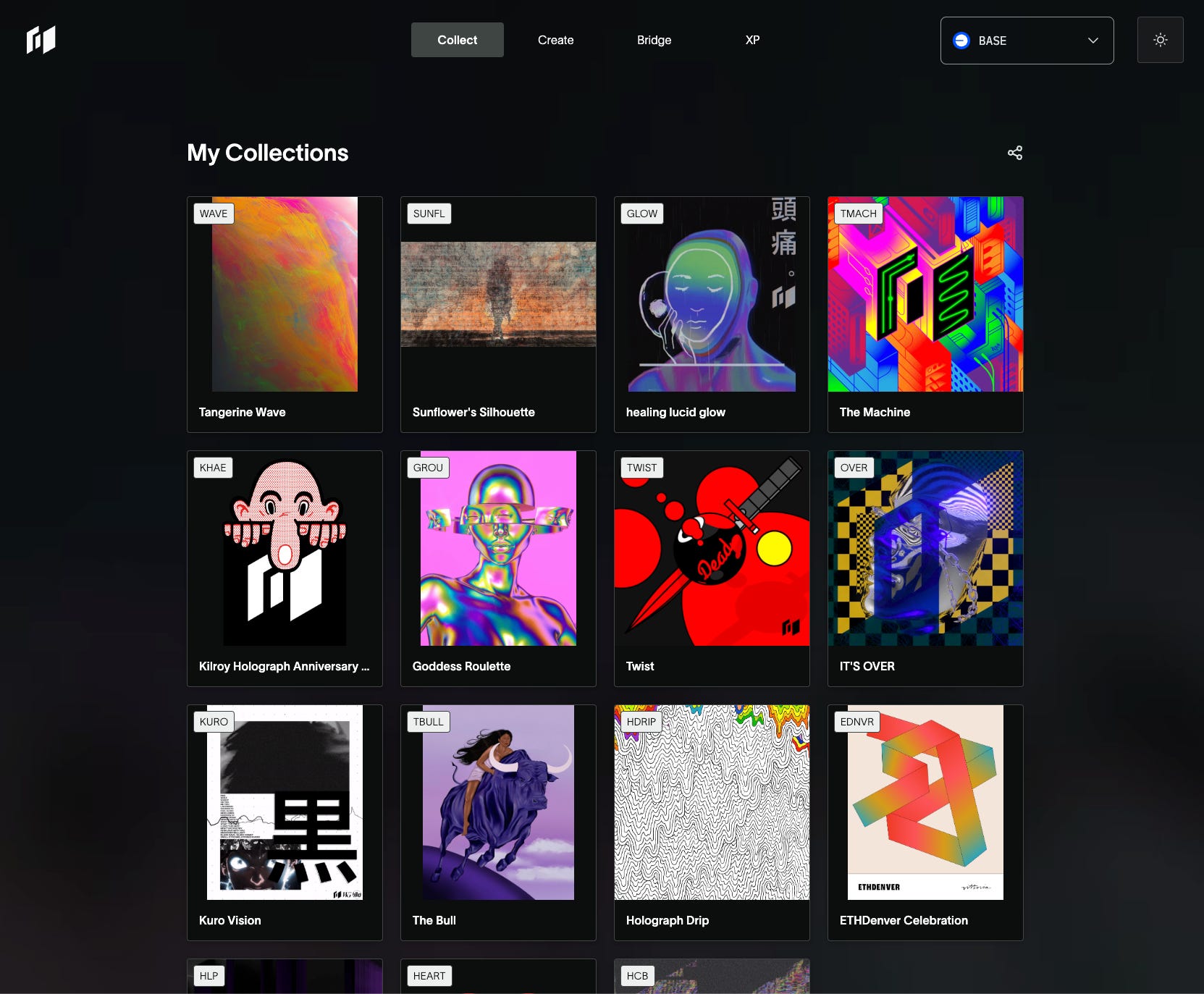
Initially, we supported extensible ERC20, ERC721, and ERC1155 token contracts, but also templatized a Holograph NFT contract that was popular with the creators we were working with. We launched the Holograph app and worked closely with a constant cadence of amazing artists as we assisted them in deploying their collections before eventually opening the app up for use by anyone.
The fire
Things really started heating up in early 2023 after we shipped a new suite of contracts that enabled creators to deploy open editions of their work. All of a sudden these timed drops started racking up millions of mints over 24 or 48 hour periods. Our servers were on fire. Our indexers and operators couldn’t keep up.
After the initial firefighting, we went heads down on building out our infrastructure to withstand the nascent onslaught of demand. There were many pair programming and devops sessions throughout the days and even into the nights and weekends. It wasn’t easy at all, but now that it’s passed, I look back at those times with genuine fondness. It was one of the most invigorating periods of my career. I learned a ton about handling extreme loads under pressure in the crucial moments, but also in the slower times after big drops as we continuously optimized parts of our process and/or stack that we believed could be improved.
This continued through much of 2023 and didn’t slow down. We continuously iterated on design and UX on the frontend while building additional token standard types, rolling out to new networks, improving our developer tools, indexers, and crosschain operators. I might be biased, but I truly believe we had some of the best design and UX in the token launching space during this time.
Scaling up
By 2024 we raised a new round of funding that allowed us to go heads down on V2 of the Holograph Protocol and prepare to open the operator network to the public. A core tenet of the operator network required an economic layer to incentivize operators to participate for nominal fees for their work executing crosschain bridge transactions. It was essentially bridge mining.
This was a sophisticated system that we knew had to work correctly for the mechanics to play out favorably for all participants, users and operators alike. Designing this from an architectural perspective was another highlight of a challenge because we knew we were operating in an adversarial space and that inevitably various actors would be doing whatever they could to game the system.
It also became pretty obvious that much of the increases in demand was driven by relentless bot activity as the industry started to anticipate the airdrop playbook. HLG (the network token of the Holograph Protocol) was required as collateral for the functioning decentralized operator network, so we had to go back to the drawing board and figure out how we could fairly distribute tokens to honest participants. This involved a number of frameworks, limited by regulatory and legal requirements, but much of those aspects were out of my hands. Where I was able to contribute was on the technical side designing the algorithm to be sybil resistant. That was an incredibly tricky but unique design space to think in.
At a lower level, we also needed to make it possible for operators to easily participate in the network. That meant going heads down on the CLI we built to make it easy for external contributors to spin up the Operator client in a seamless way, which required us to abstract many of our internal tools and learnings into a package for the public to consume.
In the summer of 2024, the HLG token went live. What came next would test everything we had built.
What we shipped
We operated across 10+ blockchains. That meant dealing with different finality assumptions, different RPC failure modes, different reorg depths, and chain-specific edge cases that don’t exist in single-chain work.
Over four years:
11M+ unique tokens
600k+ contracts
15M+ transactions
Millions of wallets
We also proved there was a business, at least for a period:
~$4M annualized revenue at peak
Optimism RetroPGF grant
Collaborations with some amazing artists and brands
The hard parts
There were many ups and downs throughout the journey. Technical issues. Product dead ends. New narratives that seemed to suck up all the attention on the timeline.
Distribution turned out to be our biggest hurdle. We proved time and again that we could build slick product experiences, but the audience didn’t always materialize.
The darkest days followed a security incident where a contractor with privileged access exploited that trust to mint a large amount of additional HLG. This happened just a month after the token went live. It forced decisions with incomplete information, communication when you can’t promise outcomes, and supporting users through chaos as the market responded to the side effects of the event.
We brought Halborn on retainer and spent two months fully revamping our operational security while working with legal authorities. We stabilized the ship and put our heads down to keep building. That period changed how I think about operational security, access controls, and accountability under pressure.
But despite our best efforts, the attack was a major setback and became the turning point of our momentum. We spent the next 12-18 months first trying to recover, then pivoting to new product offerings after demand for the Holograph Protocol never returned. It wasn’t all because of the exploit. There had been major narrative shifts and consolidation amongst a few major chains and L2s, namely Base. We had lost time, resources, and personnel after the attack, and we weren’t able to move with the same velocity or adapt the protocol fast enough to changing user needs.
On a personal note, in the fall of 2024 after the incident, I was expecting my first child and ultimately had to step away for some time to be there for my growing family. I only took one month of parental leave, feeling torn but also a sense of urgency to help get our business back on track.
The pivots
As 2024 ended, we spent most of 2025 trying to find new product-market fit with new offerings. All of these efforts were attempts to bring value back to the Holograph community and stakeholders, but weren’t directly extensions of the Holograph Protocol.
The first major application we deployed was Gains.Meme, a memecoin trading app for the Base ecosystem. Solana was having its moment for memecoins and we noticed a void in similar experiences on Base. We released the app as a PWA initially but found limited traction, concluding later that the memecoin community was just much more prevalent on Solana and the same demand didn’t exist on Base.
Later that year we continued with another experiment building on top of the growing Farcaster network with BattleCast, a Farcaster mini-app that was a novel type of prediction market.
These development experiences provided me a nice temporary reprieve from the deep protocol and infrastructure engineering I had spent the majority of my time contributing for Holograph Protocol up to that point.

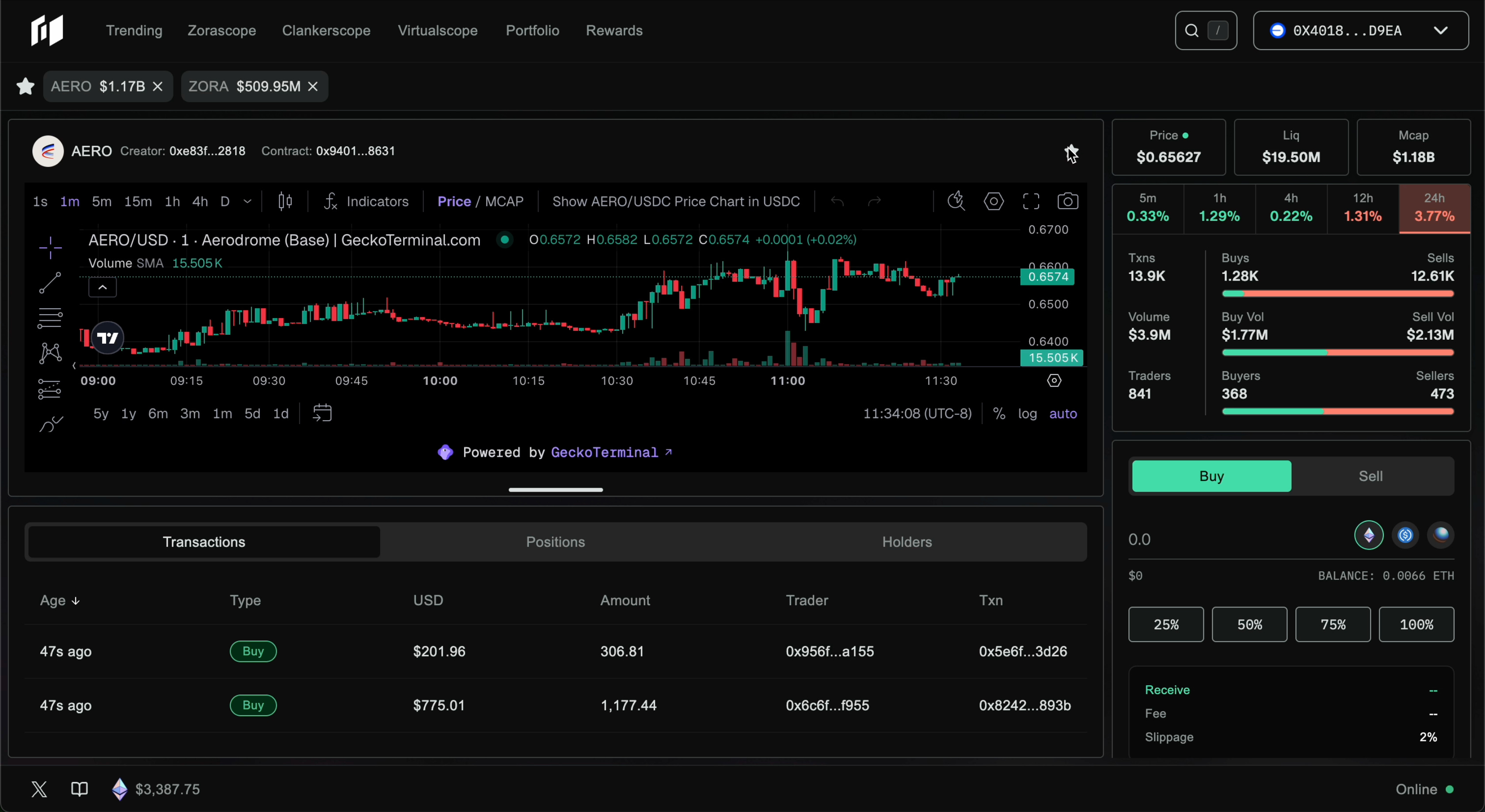
Finally, towards the end of 2025, after none of these pivots were panning out, I made a bit of a hail mary proposal to the team: return to the Holograph brand, release a new updated version of the protocol, and enable staking rewards for HLG holders. That kick-started what would inevitably be the final episode of Holograph, culminating in the release of Holograph Terminal.
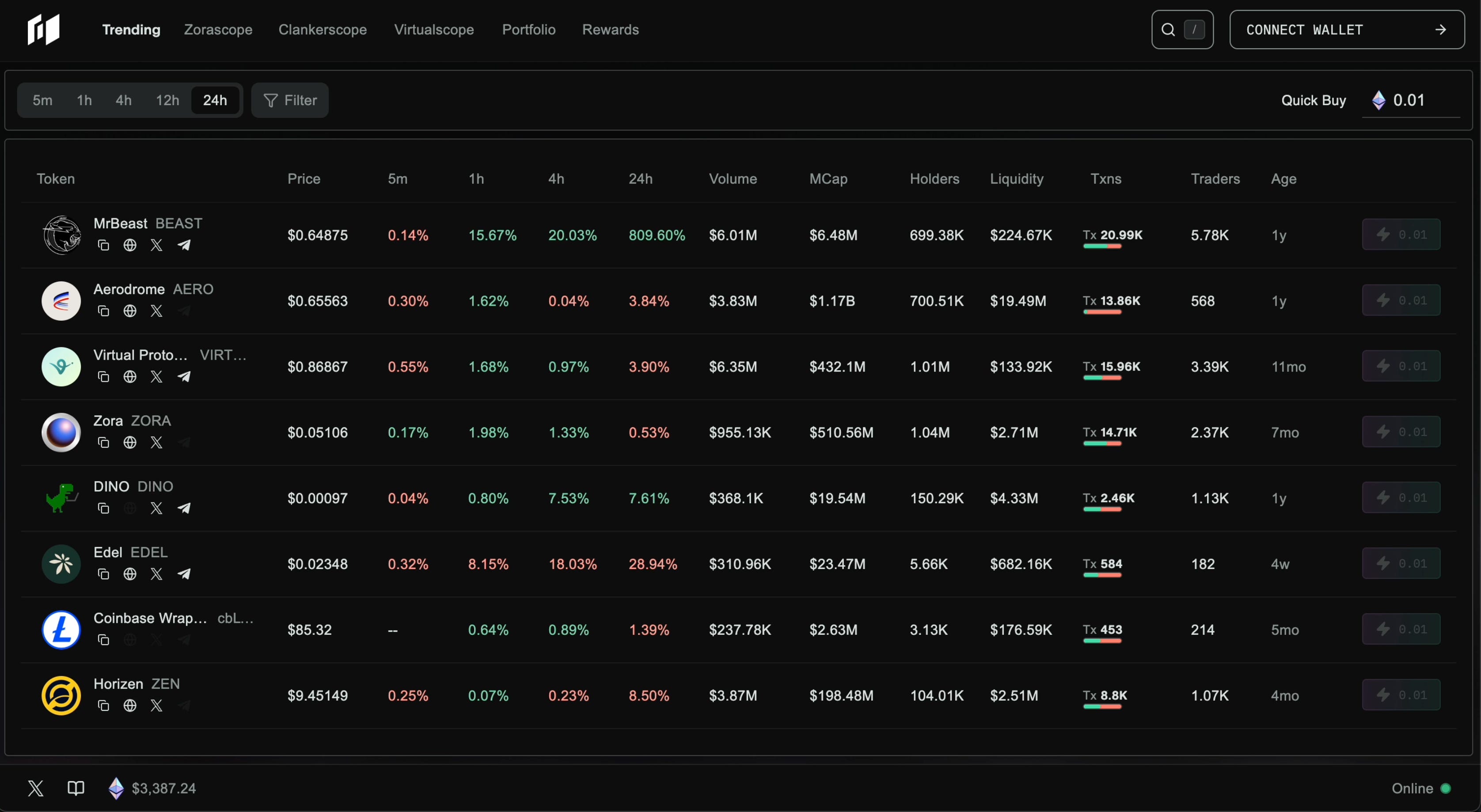
For these projects I wore a lot of hats. I wrote all the new Solidity for the core BattleCast prediction market contracts, as well as the new version of the protocol complete with staking rewards, token launch mechanics, multisig operation interfaces, and updated asset template contracts. I also wrote a ton of TypeScript: a suite of APIs including PnL data dashboards, transaction routing logic, database migrations to handle the referral system, and internal tools like automated Tenderly utilities and deployment helpers.
Why we stopped
After everything we shipped, the product wasn’t finding sustainable demand.
We iterated. Tried different angles. The signal stayed consistent: usage existed, but it wasn’t compounding. Users weren’t coming back unprompted. Integrations churned instead of deepening. Revenue spiked and faded.
At some point we realized we had to stop trying to force it. The market didn’t return the signal we needed so we took a step back and decided it was time to spin things down.
What’s next
I’m staying in crypto. I still believe in the sovereign promise this technology offers and I want to keep building protocols that support it.
My experience leans toward backend and protocol work, but I’ve also shipped consumer-facing applications and care a lot about building APIs and services that support delightful user experiences. I’m comfortable working up and down the EVM stack and have been spending more time in the Solana ecosystem lately as I continue to expand my range. Day to day I’m writing TypeScript, Solidity, and more recently Rust, with plenty of Go and Python in my past.
I like projects with high autonomy and high responsibility, teams where agency is a virtue and ownership is expected. I’ve also scaled engineering teams and led developers for many years, so I’m excited about leadership roles and mentorship opportunities.
If any of that overlaps with what you’re building, I’d like to talk.
To everyone who used Holograph, integrated with it, or followed along: thank you.